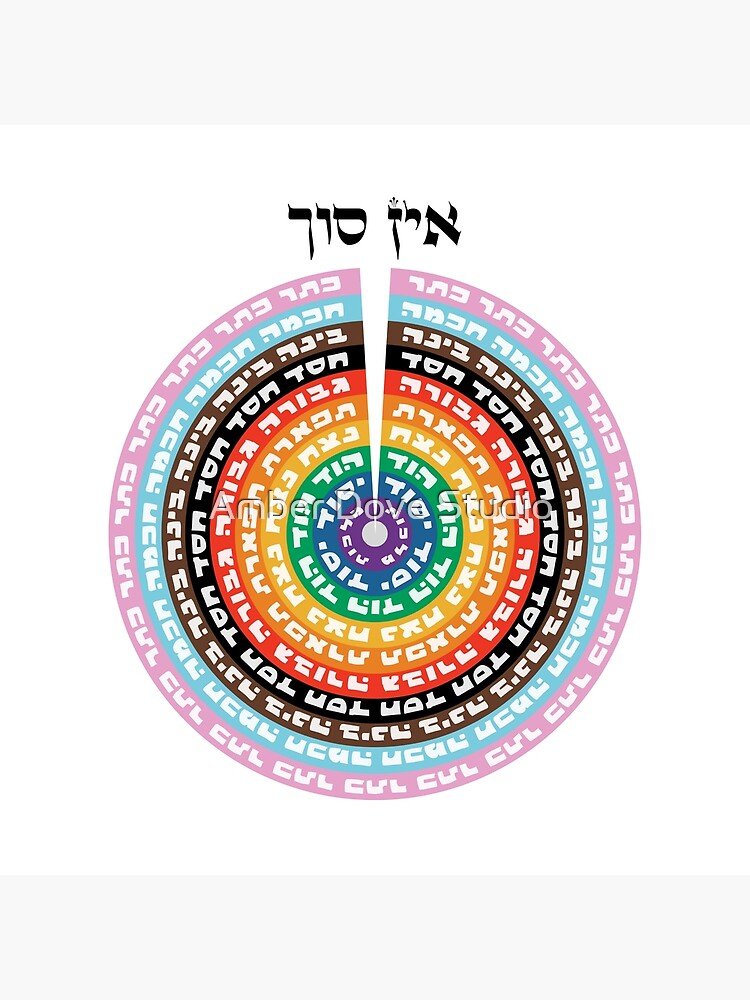
Tzim Tzum

After the unimaginable depth of the Infinite Before-All, where God exists in absolute simplicity — without division, without attribute, without boundary — something extraordinary occurs. Not in time, because time has not yet emerged, and not in space, because space does not yet exist. It is a change without change, an act without motion, a transition without before or after. The mystics call it Tzimtzum — the primordial withdrawal or contraction, the first gesture that makes creation possible.
To understand this event, we must first remember what came before: the Infinite was all that was. Not “all” in the sense of many things, but all in the sense of utter, indivisible fullness. There was no “place” where something else could be, because “place” did not exist. There was no difference between inner and outer, no separation between source and manifestation. Everything was swallowed in the infinite simplicity of the Unconditioned.
So how does something arise from that which contains no distinctions? How can the finite appear from the Infinite? How can a world exist that is not God, when God is beyond the very idea of “otherness”?
This is the paradox at the heart of Tzimtzum.
The Infinite, in its boundless fullness, performs what seems like a contradiction: It makes room for what is not Itself.
But how can the Infinite make room? There is no border to push outward. There is no space to clear. There is no “movement,” because movement assumes two points, and no such points exist yet.
Thus Tzimtzum cannot be understood as a physical withdrawal. It is not a retreat into a cosmic corner, nor a shifting of divine presence. Rather, it is a veiling, a concealment, a self-limitation — an act of infinite humility. The Infinite, which needs nothing, chooses to refrain from overwhelming reality so something other can appear.
This is the first great paradox:
The Infinite reveals itself by concealing itself.
In this concealment, a kind of “empty space” appears — but it is not truly empty. It is a space defined not by the absence of God, but by the hiddenness of God. A region in which the overwhelming radiance of the Infinite is softened, dimmed, veiled. A womb where existence can take shape without being immediately dissolved back into the Absolute.
This “space” is not physical. It is more like a possibility-space — a domain in which finitude becomes possible. Think of it not as emptiness, but as a carefully calibrated distance, the first boundary, created so that distinction can exist without being annihilated by the Infinite’s overwhelming unity.
The mystics describe this space as a kind of circle, not literally round, but symbolizing a perfect, balanced opening. Within this opening, something unprecedented becomes possible: the emergence of relationship. For the first time, there can be a “here” and a “there,” a “self” and an “other,” a “world” and a “beyond-world.” The Infinite, by choosing to conceal its boundlessness, creates the first possibility for separation — not as an abandonment, but as the beginning of love, freedom, and story.
It is important to understand that Tzimtzum is not an act of deprivation, nor a loss within God. The Infinite remains Infinite. Nothing can diminish Him. The “withdrawal” is only for the sake of the emerging world, not a subtraction from the divine fullness. The Infinite remains everywhere, but hidden. The presence is total, but the revelation is limited. Like light streaming through a thick curtain, the rays that reach the created realm are gentle enough to allow form, individuality, and growth.
Without this softening, creation would not merely fail to exist — it could not even be conceived. The Infinite’s absolute unity is so total that no separate being could stand before it. Tzimtzum is the cosmic kindness that permits separation without destruction, individuality without illusion, striving without annihilation.
This “first concealment” is also the beginning of freedom.
If God were fully obvious, radiant, undeniable, nothing could stand apart, nothing could choose, nothing could grow. The emergence of a world requires the possibility of distance, of seeking, of longing, of discovery. Tzimtzum provides the stage for spiritual evolution. It gives creation the dignity of its own journey.
In this sense, Tzimtzum is both a cosmic act and a cosmic gift.
Tzimtzum also introduces the possibility of perception. Beings can now experience a world that appears independent, a world where actions matter, where choices change outcomes. Without concealment, all events would dissolve into divine unity. With concealment, the drama of existence becomes meaningful, because beings can seek the hidden Source through their own free will.
There is a profound humility embedded in this act. The Infinite voluntarily steps back, as it were, so that others may come forward. The greatest power expresses itself as restraint, gentleness, and patience. The Infinite does not dominate creation — it nurtures it.
The second great paradox is this:
Only the truly Infinite can hide Itself without diminishing.
Finite things vanish when concealed. The Infinite becomes reachable through concealment.
In this way, Tzimtzum is not merely a cosmological principle; it is a teaching about the nature of spiritual life. Within us, too, there are veils. Within us, too, the divine presence is hidden so that we may seek, discover, and grow. The spiritual journey is not to escape the concealment, but to recognize the light that shines through it. The veils are opportunities. The hiddenness is an invitation.
Tzimtzum is the first invitation.
It prepares the space for a universe filled with multiplicity, freedom, and purpose. It is the dawn of the possibility of relationship — the Infinite relating to the finite, the hidden Source whispering through the contours of creation.
From this point forward, the story of existence begins. Worlds will emerge. Light will descend. Souls will take form. And through all of it, the Infinite will remain both hidden and present, distant and intimate, unknowable and yet the deepest truth within all things.
Tzimtzum is therefore not the absence of God.
It is the beginning of the world’s ability to find Him.